Building a Desktop Wireframe Octopus: Kinetic Art Meets Precision Engineering
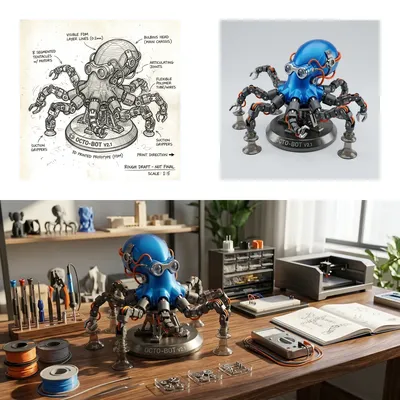
How open-lattice wireframes, gear mechanisms, and high-detail resin printing created an articulated desktop mechanical octopus sculpture.
The tentacle assembly clicked into place at 2 AM. The studio was dead quiet except for the low hum of the exhaust fan. Under the desk lamp, the articulated mechanical octopus didn't feel like another plastic trinket. It felt alive. Open-lattice limbs caught the light, throwing web-like shadows across grid pads and aluminum tool trays.
We avoided building a generic desk toy. We wanted a physical anchor demonstrating what happens when fluid biology meets rigid mechanical engineering. Cephalopods move with uncanny efficiency. Translating that organic motion into raw, exposed architecture required weeks of sketching, failed prints, and endless CAD revisions.
From Concept Sketch to Physical Prototype
Most desktop art sits inert. It collects dust and fades into the background within a week. We chased weightlessness—an exposed skeleton where every gear tooth, pivot pin, and strut had a clear structural purpose. Dialing in those razor-thin lattice struts meant driving our hardware right to its physical limits.
We began with fast FDM printing runs to lock down scale and mass distribution. Early builds failed quickly; the arms drooped under their own mechanical weight. Shifting to a high-resolution resin print process resolved the physics. It locked complex overhangs and micro-joints in place while keeping the core frame rigid.
- Exposed Wireframe Mesh: Light pierces the torso, revealing internal gear tracks and movement pathways.
- Fully Articulated Arms: Multi-segment limbs bend across monitors, audio interfaces, or stack cleanly over notebooks.
- Matte Industrial Finish: Zero surface sheen. It looks and feels like an R&D prototype pulled straight off a hardware bench.
Bringing Kinetic Geometry to the Desk
Set it on a dark walnut desk alongside a mechanical keyboard and an audio interface. The room's tone shifts immediately. Studio visitors skip the monitor arms and custom lighting. They walk straight over, pick up the machine, and start adjusting the limbs.
That tactile response sits at the core of custom product design. Mid-afternoon creative blocks happen; staring at blank viewports solves nothing. Grasping an object with twenty mechanical pivot points gives your hands work to do while your focus resets. It acts as a visual anchor—industrial geometry balanced against organic curves, right beside your coffee mug.
Precision 3D printing turned an aggressive concept sketch into functional desktop hardware. It isn't passive decor; it proves engineering rigor and artistic design fit within the exact same footprint.
FAQ
How large is the octopus robot, and will it take up too much desk space?
It occupies an 8-by-8-inch footprint at full extension. The open lattice structure maintains visual transparency, so it never feels bulky on your workstation.
Is the wireframe structure durable, or will it break if dropped?
The thin geometric mesh looks fragile, but high-density resin gives the struts real flex and structural strength. It easily withstands daily posing and repositioning, though hard drops onto concrete should be avoided.
Can I request custom colors or finishes for my studio setup?
Yes. Our custom product design workflow offers matte dark gray, industrial white, and specialized metallic resin finishes tailored to your workspace aesthetic.
Are the tentacles fully posable or glued in place?
Each arm uses multi-segment mechanical ball joints. You can bend, rotate, and wrap the limbs around pen pots, monitor mounts, or desktop hardware.
You may also like
Contact us: support@memorieslab.co
← Back to gallery