Engineering a Robotic Sea Snake: Titanium Meets Biomimicry
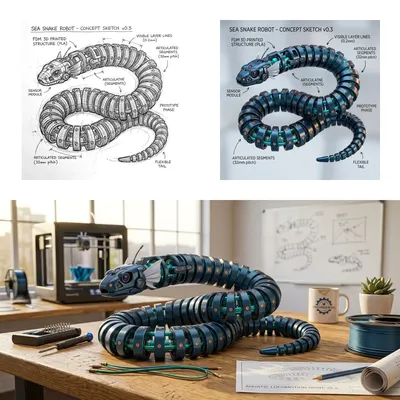
Inside the studio behind an articulated serpentine robot built for deep ocean surveys and kinetic art display.
Morning light streams across the workbench, catching half a dozen polished metal segments laid out like a titanium spine. Outside, seagulls wheel over the harbor. Inside, only the low hum of a bench lathe and the crisp snap of stainless steel pins interrupt the silence.
A dive trip off Palau three years ago changed our approach to marine robotics. Watching banded sea kraits thread narrow coral crevices effortlessly made standard submersibles look primitive. Conventional submersibles are bulky, loud, and disrupt fragile aquatic life. We needed fluid movement—a platform that navigates water rather than bludgeoning through it.
From Desktop Prototypes to Marine-Grade Titanium
Before cutting expensive metal stock, we spent months prototyping in plastic. Rapid iterations on an FDM printing rig let us dial in joint clearances and serpentine sway. Standard PLA handled macro geometry validation, but lacked the precision needed for compact internal gear housings.
For those intricate internal assemblies, we switched to a high-resolution resin print workflow. Micron-level accuracy delivered snap-fit functional prototypes in hours, allowing us to validate micro-fluidic channels before committing capital to metal fabrication.
Once the math proved out, we transitioned to grade-5 titanium. Each segment houses a dedicated brushless motor, harmonic drive gearing, and dual micro-O-ring seals rated for extreme pressure. Because every unit relies on custom product design, no two builds leave our bench identical. Some clients specify multibeam sonar heads; others order a striking kinetic centerpiece for an oceanographic institute lobby.
Functional Engineering Meets Kinetic Sculpture
On paper, it qualifies as an autonomous underwater vehicle (AUV). In hand, it carries the weight and feel of functional art. The bead-blasted titanium surface scatters sunlight across our working drawings in sharp geometric patterns.
Core mechanics driving the serpentine chassis underwater:
- 24 articulated joints delivering continuous 360-degree undulation
- Additive titanium 3D printing creating lightweight, pressure-resistant shell structures
- Modular nose cone accommodating dual 4K camera arrays and payload sensors
- Direct magnetic couplings ensuring completely sealed, leak-free power transmission
Whether weaving through delicate reef structures to monitor marine life or mounted on a dark walnut base in a research lab, this robot bridges heavy field equipment and sculpture. Silent, precise, and built for harsh saltwater depths.
FAQ
Can this robotic sea snake actually be submerged in ocean water, or is it just a display model?
It is engineered for active sea deployment. Dual micro-O-ring seals and magnetic couplings across every titanium module protect components down to 50 meters depth. A simple fresh-water rinse after ocean trials keeps the articulated joints free of salt build-up.
What options are available for custom product design and sensor payloads?
We engineer custom head and tail assemblies based on mission parameters. Payload options include acoustic Doppler current profilers (ADCP), multibeam sonar systems, high-resolution optical rigs, or bespoke water sampling modules tailored to your research focus.
How were the early prototypes tested before moving to titanium?
We calibrated body dynamics using rapid FDM prints for physical scale testing, followed by high-precision resin prints to verify tight internal gear tolerances prior to metal machining and additive titanium fabrication.
How long does a custom build take from order to delivery?
Because each system demands tailored titanium 3D printing, precision CNC post-processing, and hand assembly in our workshop, standard build times range from 8 to 12 weeks.
You may also like
Contact us: support@memorieslab.co
← Back to gallery