Form Follows Focus: The Story Behind Our Camera-Shaped Glass Magnifier
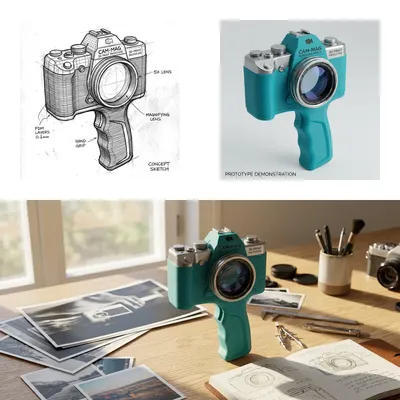
A heavy, tactile studio magnifier built for creators who value precision and the mechanical feel of vintage camera gear.
The Spark: A Vintage Rangefinder and a Desk Full of Proofs
Last winter, sitting over a stack of fresh risograph proofs, I picked up the plastic dome magnifier sitting on my drafting table. It did the job, but it felt disposable. Right beside it rested a 1960s mechanical rangefinder—solid brass, cold to the touch, with crisp diamond knurling that felt pristine after sixty years.
That contrast nagged at me. Why shouldn't a daily inspection tool carry that same weight and physical precision?
That question turned into a month of intensive custom product design. The goal: engineer a desktop magnifying glass that feels like an unmounted prime lens. A tool with real heft. Something that prompts you to slow down and inspect your work with intention.
From Rough Print to Desk Companion
Adapting optical housing for a desk surface took iteration. Standard camera barrels sit on mounts; they aren't designed to rest flat on print stock without trapping shadows or scratching paper. We cut angled light channels into the base rim, letting ambient light flood across the page even when you lean in tight.
We kicked off prototyping with in-house 3D printing to test ergonomics and barrel thickness. Early FDM printing mockups helped us evaluate how the housing rested across different hand sizes. From there, we jumped to high-resolution resin print iterations to refine the knurled focus ring, dialing in the precise mechanical bite of classic camera gear.
A Daily Ritual for the Detail-Obsessed
This isn't a tool you stash in a drawer. It sits on your workspace like a functional desk sculpture—right alongside draft pencils, ink bottles, and cutting mats.
Where it earns its place in the studio:
- Inspecting Fine Art Prints: Evaluate ink registration, paper tooth, and halftone fidelity without eye strain.
- Reviewing Pencil & Ink Sketches: Examine line density, graphite texture, or stippling before high-res scanning.
- Small-Craft Quality Control: Check paintwork, leather stitching, or surface coatings up close.
When inspection stops feeling like routine maintenance and starts feeling like part of the creative process, quality tightens up. It also looks outstanding resting on a solid wood desk.
FAQ
What optical magnification power does it offer?
It uses a ground 5x optical glass lens optimized for print dot inspection, pen strokes, and surface textures, keeping edge distortion to a minimum.
How heavy is it, and will it shift on the desk?
It weighs roughly 320 grams. The solid housing gives it sufficient weight to anchor rolled prints, blueprints, or loose proof sheets.
How was the grip knurling designed?
We prototyped the knurled pattern using high-detail resin prints, testing pitch and depth until we matched the sharp diamond texture of manual focus rings.
Are custom orders available for design studios or client gifts?
Yes. We provide studio customization, including laser-engraved studio branding or personalized text along the lower bezel.
You may also like
Contact us: support@memorieslab.co
← Back to gallery