Spider-Legged Off-Roader: Wireframe Art Takes on the Wild
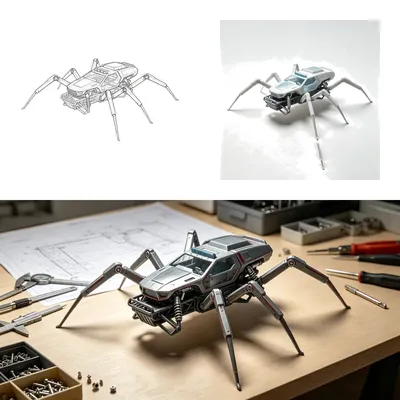
Imagine a vehicle that’s part sleek sculpture, part unstoppable off-road machine.
Ever look at a sleek, minimalist sculpture and think, "Man, I wish I could drive that over boulders?" Yeah, me too. There’s something undeniably cool about a design that’s stripped down to its essentials, yet still packs a punch.
That's the vibe we're chasing with this conceptual spider-shaped off-road vehicle. We're talking less about a traditional SUV and more about a mechanical arachnid. It’s a striking fusion of clean, almost skeletal wireframe art and pure, unadulterated rugged adventure. Think about tackling a gnarly rock garden, not just cruising a flat trail. This isn't just a vehicle; it's a statement. A rolling piece of art that laughs in the face of rough terrain.
Design Meets Durability: How We Get There
Crafting something this unique isn't a job for old-school manufacturing alone. This is where modern tech really shines. Imagine bringing a concept like this to life. It starts with an idea, sure, but then you need to prototype. Quickly. Affordably.
That's where 3D printing becomes your best friend. For initial mock-ups, larger components, or even some structural parts, FDM printing lets you churn out prototypes relatively fast. We're talking about testing different articulation points for those spider legs, figuring out weight distribution, and refining the overall chassis design. You can rapidly iterate on complex geometry, checking how those minimalist lines actually hold up in a physical form.
For the finer details, maybe interior elements, or even smaller, more intricate exterior panels, a high-quality resin print offers incredible precision. This lets designers get very specific with surface finishes and tiny structural elements that tie the whole minimalist aesthetic together. It's about getting those crisp edges and smooth curves just right, even on something meant to get muddy.
The whole process leans heavily on custom product design. You're not just picking parts off a shelf here. Every single component, from the articulated joints to the cabin frame, is designed specifically for this vehicle. This isn't a factory line; it's an artist's workshop, just with more sophisticated tools.
Beyond the Show Car: Real Adventure
So, it looks cool. But can it actually *do* anything? Absolutely. The spider form isn't just for looks. Those multi-jointed legs? They're about extreme articulation. Picture navigating terrain that would leave a regular 4x4 stuck and spinning its wheels. This thing can step over obstacles, adapt its stance to uneven surfaces, and probably even climb things that look impossible.
The wireframe aspect, while visually light, can be incredibly strong if engineered right. Think about geodesic domes or truss bridges – lots of strength from minimal material. It’s about smart engineering, not just brute mass. This vehicle would be surprisingly nimble, with a low center of gravity when needed, but also the ability to raise itself to clear obstacles. It’s a new way to think about getting off the beaten path. It's about being unconventional, capable, and undeniably eye-catching.
FAQ
Is a spider-shaped vehicle actually practical for off-roading?
Good question. While it looks futuristic, the multi-legged design offers huge advantages for extreme terrain. Each leg can articulate independently, letting the vehicle "step" over rocks or across gaps a traditional wheeled vehicle couldn't manage. It's about adapting to the ground, not just rolling over it.
How durable would something with a wireframe design really be?
Don't let the minimalist look fool you. The strength comes from intelligent engineering and material choice, not just bulk. Think about how a truss bridge works; strong geometry can be incredibly robust with less material. It's designed to be tough where it counts, while keeping weight down for better performance.
How does 3D printing help build such a complex design?
<b>3D printing</b> is essential for this kind of vehicle. It lets designers rapidly prototype and test complex parts like the leg joints or unique chassis elements. You can quickly print different versions, check fit, and refine the design without huge manufacturing costs. It really speeds up the process of turning a wild idea into a tangible, working concept.
You may also like
Contact us: support@memorieslab.co
← Back to gallery