Form Meets Function: Why the Hammer Flashlight Earned a Permanent Spot on My Workbench
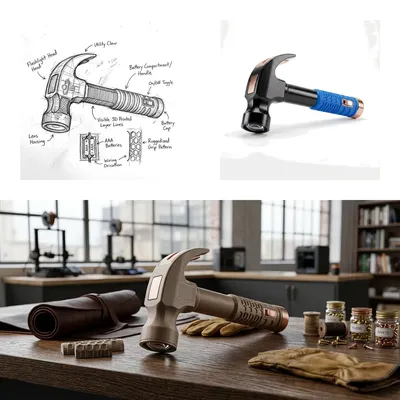
A look at how an eccentric tool combining brute force and focused light became an essential studio companion.
Born from Late-Night Bench Chaos
Late one Tuesday night, while trying to hold a standard plastic penlight between my teeth to solder a tiny board, I dropped the damn thing. It rolled straight under a heavy storage shelf, right as I needed to tap a brass alignment pin flush. Frustrated and crouched on the floor with a flashlight in one hand and a small mallet in the other, I thought: why can't these two tools just be the same object?
That spark kicked off months of sketching and prototyping. Early iterations relied on quick FDM printing using tough PETG filaments just to test the weight, balance, and hand feel. Once the ergonomics clicked, we shifted to high-resolution resin print components to dial in the delicate lens housing and handle knurling. The goal was simple—create a piece of custom product design that could survive real studio abuse without looking like cheap hardware store plastic.
Heavyweight Performance on the Studio Desk
Pick this torch up and you immediately feel the mass. The solid aluminum body houses a focused LED pod where the hammer face sits, while the opposite end features a hardened tungsten tip. Need to inspect a tight stitch line or a faint solder bridge? Flare the beam. Need to seat a wooden dowel or tap a metal bezel into place? Flip it around and use the head.
Standard flashlights love to roll off angled drafting tables and slide around messy workbenches. This one stays exactly where you set it down. It feels like an extension of your arm rather than an awkward gadget.
A few features that make it stand out on a daily basis:
- Solid weighted head designed for light assembly and alignment work
- 800-lumen wide-beam LED with a natural 4000K tint to reduce eye strain
- Flat-edged geometry that stops the light from rolling off angled surfaces
- Hidden USB-C charging port sealed inside the handle against metal dust
It sits on the studio desk looking like a sleek sculptural piece, but it works like an absolute draft horse. That is the real magic of modern 3D printing—it lets us turn bizarre, highly specific ideas into rugged physical tools that elevate how we build things every day.
FAQ
Is the hammer head durable enough to actually strike metal and wood on the bench?
Yes. While it will not replace a two-pound sledge for heavy framing, the solid aluminum head and tungsten tip are built for practical studio tasks like tapping brass pins, seating wooden dowels, or adjusting press fits without damaging the internal LED.
How did you prototype the physical shape before production?
The initial grip and balance were refined using FDM printing to quickly test different handle lengths and weights. Once the balance felt right, high-detail resin print components were used to test the optical lens housing and fine knurling patterns before final machining.
What kind of light output does this flashlight produce for detail work?
It pushes up to 800 lumens with a warm 4000K color temperature. We deliberately chose this warmth over harsh blue-white light because it renders colors accurately and reduces eye fatigue during long hours of soldering or detailed handcrafts.
How is the charging port protected from workshop debris?
The USB-C port is hidden beneath a threaded aluminum cap at the base of the handle. A rubber O-ring seals the threads, keeping fine wood dust, metal shavings, and bench grime entirely away from the electronics.
You may also like
Contact us: support@memorieslab.co
← Back to gallery