Engineering Cybernetic Muscle: Carbon Fiber, Steel, and Algorithmic Precision
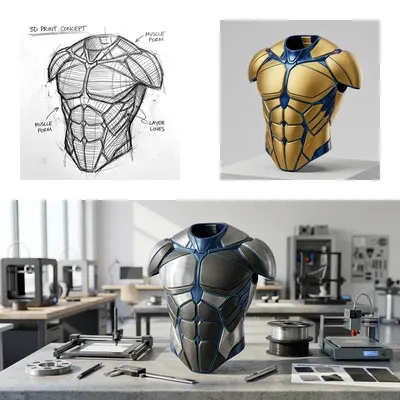
Merging classical anatomical sculpture with hypercar composite engineering inside a modern prototyping studio.
Late night on the shop floor. One bench held a cast replica of a Greco-Roman cuirass. The other held the exposed carbon-fiber chassis of a track bike. The contrast was stark: ancient metal celebrating raw human anatomy on one side, computational geometry chasing aerodynamic speed on the other. That clash sparked a single directive: translate physical power into parametric wireframes and build wearable muscle armor.
From Cybernetic Wireframes to High-Tech Studio Prototyping
Translating human deltoids, pectorals, and abdominal contours into aggressive polygonal facets demands extreme mathematical discipline. Shift an angle by three degrees, and the silhouette turns into a clunky prop instead of a seamless kinetic extension. We spent months running digital iterations, pinning geometric nodes to dynamic anatomical flex points so the facets catch razor-sharp highlights without pinching the shoulders.
Prototyping forced us to blend additive manufacturing techniques. Early spatial test prints ran on large-format FDM printing arrays to lock down scale, flex, and torso clearance on living models. For high-tolerance mechanical hinges and internal wireframe conduit channels, we pivoted to high-resolution resin print setups. This hybrid process yielded glass-smooth master molds for hand-laying carbon fiber alongside polished structural steel accents.
Where Anatomic Power Meets Real-World Wear
Who armor-plates human anatomy in structural carbon and steel? We engineered this chassis for creators and collectors demanding absolute physical presence.
- Stage and Screen: Production designers wanting hero armor that holds camera focus under hard studio lights without flexing like painted foam.
- Haute Couture & Runway: Stylists fusing structural wearable tech with high-concept avant-garde silhouettes.
- Private Galleries & Lofts: Art directors seeking an industrial centerpiece that commands space mounted on a wall bracket or displayed on a torso.
Strap in, and the center of gravity rests low on your hips, pinning the weight broad across your shoulders. It feels dense, deliberate, and indestructible.
Tailored Architecture for the Human Frame
Anatomy is absolute. Off-the-shelf chest plates fail because static geometry ruins natural shoulder movement. Every chest unit relies entirely on bespoke custom product design. We start from a high-resolution 3D body scan or precise dimensional mapping to scale the underlying wireframe engine to your exact torso height and clavicle width.
Coupling parametric CAD software with high-precision 3D printing pipelines lets us anchor every carbon panel and steel rib straight to your skeletal line. The result isn't off-the-rack body armor. It is a calculated second skin built to take impact.
FAQ
How do you capture my body dimensions for a tailored fit?
We process your raw 3D scan files or a set of eight standardized torso measurements taken at home. Through our custom product design pipeline, we adjust the parametric digital chassis so the carbon plates land precisely over your shoulders, ribs, and sternum.
Is this muscle armor actually wearable, or is it strictly a display piece?
It is fully functional and engineered to be worn. The interior houses micro-mesh padded backing linked to adjustable dynamic leather harness straps. Despite its dense metallic finish, the carbon-fiber composite keeps total weight under six pounds, letting you wear it comfortably for hours.
What role does 3D printing play in making this armor?
We deploy FDM printing to produce full-scale structural test rigs for live fitment checks, while high-resolution resin print technology generates zero-tolerance mechanical joints and master tooling. Additive manufacturing renders complex geometric wireframes that traditional metal casting simply cannot produce.
How long does production take from the moment I place an order?
Every suit involves parametric tailoring, hand-laminated carbon composites, and hand-polished steel trim. Production runs four to six weeks once you sign off on your digital fit model.
You may also like
Contact us: support@memorieslab.co
← Back to gallery